
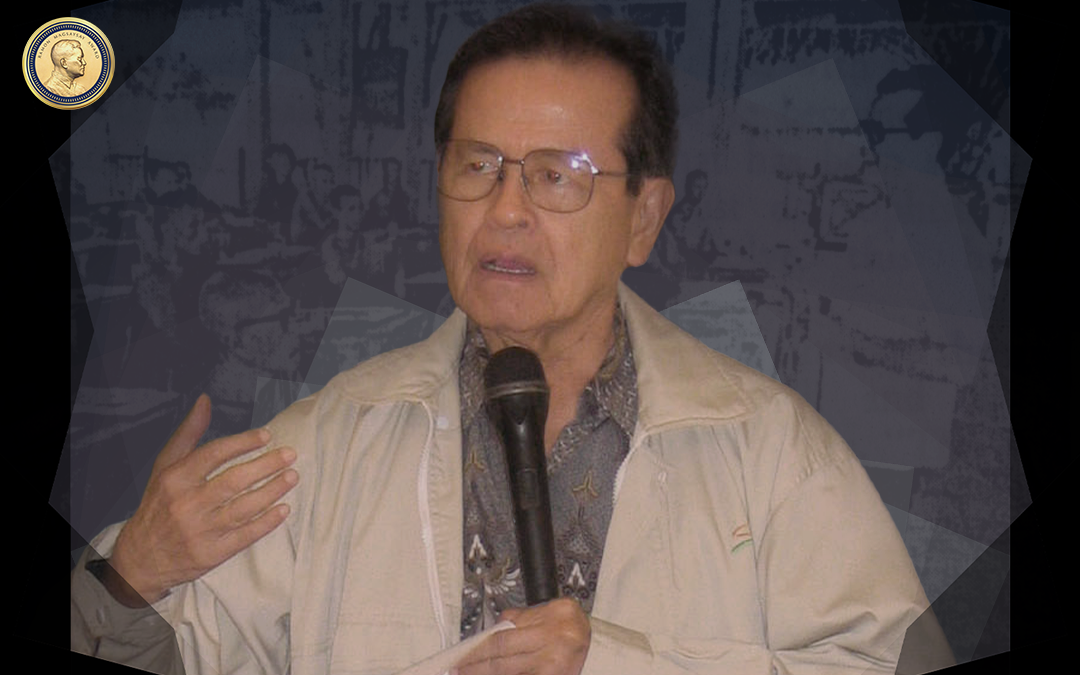
The Ramon Magsaysay Award Foundation joins the people of Thailand in mourning the passing of Dr. PRAWASE WASI, 1981 Ramon Magsaysay Awardee, whose life and work helped transform Thailand’s public health system and shaped generations of health leaders committed to service and social justice.
Dr. PRAWASE WASI was a distinguished physician, scholar, and reformer who devoted his life to advancing public health as a moral and social responsibility. Through groundbreaking research, advocacy for community-based health care, and tireless teaching, he strengthened health systems, brought modern medicine to underserved rural communities, and inspired generations of physicians to serve where the need was greatest. His unwavering dedication, transformative leadership, and greatness of spirit left an enduring impact on the health and well-being of countless people across Thailand.
In honoring his legacy, we share a dedication written by Dr. Vichai Chokevivat, co-founder of the RURAL DOCTORS MOVEMENT (RDM), a 2024 Ramon Magsaysay Awardee recognized for its pivotal role in advancing universal health coverage in Thailand. A longtime colleague and fellow advocate for equitable health care, Dr. Chokevivat’s tribute reflects both personal gratitude and the profound influence of Dr. PRAWASE WASI on Thailand’s health reform movement.
Dedication by Dr. Vichai Chokevivat follows.
Ultimately, Professor Prawase Wasi passed away from this world at the age of 93 years, 3 months, and 5 days, on Saturday, 10 January B.E. 2569 (2026), at 8:53 p.m.
Dr. Prawase was truly an illustrious son of the Kingdom of Siam.
Dr. Prawase’s father was a villager in the remote jungle in Kanchanaburi. Dr. Prawase lived through hardship and advanced through the education system, gaining admission to Triam Udom Suksa School. During that time, he had to live, eat, and sleep at Phra Nakhon School of Commerce, using students’ desks lined up together as a bed. Nevertheless, he successfully completed his medical degree , and received the Anandamahidol Scholarship to pursue further studies in the United States and the United Kingdom. While studying in the United States—where Americans are thought to be very diligent in accordance with what is known as a “Protestant work ethic”—the American professor who supervised Dr. Prawase recorded that every morning, when he arrived at his office, he found that Dr. Prawase had already begun working. In the evenings, when returning from work, he would always see the lights still on in Dr. Prawase’s office as the highly motivated student continued working. Upon graduation, most people struggle to have even a single academic article published, but Dr. Prawase had four articles published in leading journals.
After returning to Thailand, he received royal benevolence from His Majesty King Bhumibol Adulyadej the Great, who graciously had the Ananda Raj Building constructed to serve as a place for work, research, patient care, and the teaching of medical students and medical residents.
Before long, the Dr. Prawase’s reputation became widely known—for his academic excellence, his dedication and compassionate care of patients, his role as a medical teacher, and his upholding of the honor and dignity of the medical profession. Dr. Prawase was, thus, widely accepted, respected, and revered by faculty members and medical students alike, and was selected to confer degree certificates to His Majesty the King for presentation to graduating medical doctors.
After that, Dr. Prawase began to expand his role beyond that of a medical teacher by initiating reforms of the administrative system at Siriraj Hospital together with several progressive colleagues. He fought corruption, and helped to transform a hospital that had been like a “leaking well in sandy soil,” where donations flowed in from benefactors but which, nonetheless, suffered continuous financial losses, into a profitable institution. Subsequent generations of faculty took this matter seriously, resulting in Siriraj Hospital and Mahidol University becoming among the best-endowed universities in the country.
Dr. Prawase then broadened his efforts to reform medical education and the Thai Medical Council, establishing a system of specialist medical training to address the problem of Thai doctors emigrating abroad to study and practice medicine in wealthier settings. Dr. Prawase’s efforts not only resolved the issue but also enabled Thailand to produce a large number of medical specialists domestically at a cost many times lower than sending them to study overseas.
When the Royal Plaza Hotel building collapsed in Nakhon Ratchasima in 1993, Thai doctors were able to crawl down to amputate the leg of a victim trapped beneath the rubble, while an anesthesiologist administered anesthesia through another tunnel which the patient stuck with face downward. The surgery was successfully performed , and the victim’s life was saved. Even when the amputee went into shock at the mouth of the pit after the operation, the team was able to reverse the shock and transport the patient to Maharaj Nakhon Ratchasima Hospital, and later transfer her for further treatment to Bhumibol Adulyadej Hospital.
Thailand’s medical and public health system which, at present, has been able to develop into a medical hub generating substantial income for the country, has in part benefited from the system for producing medical specialists that began some 50 years ago.
After the “reform of the medical system,” which included systematic critique of medical ethics through the publication of the article series “Annals of Thai Medical Practice,” Dr. Prawase came to see that the Thai medical system was merely a subsystem of the broader public health bureaucracy. He therefore expanded his role to work with leading public health figures such as Dr. Somboon Watcharothai, Dr. Pairoj Ningsanond, Dr. Amorn Nontasoot, Dr. Banlu Siripanit, and other senior administrators. Through this collaboration, Dr. Prawase learned about the broader world of the public health system, and found that these progressive public health professionals still lacked sufficient barami (moral authority and influence) to effect needed change . It thus became necessary to seek someone with such barami to serve as the “standard-bearer” or leader of the movement. That person was found to be Prof. Dr. Sem Pringpuangkaew who, together with Field Marshal Plaek Phibunsongkhram and Luang Nit Vejjavijit, had established provincial hospitals in ever y province and founded many nursing schools, producing nurses who could be deployed nationwide. Dr. Prawase therefore went to invite Dr. Sem to join the “reform movement.”
At the same time, Dr. Prawase authored a foundational text on public health system reform entitled “Public Health for the Masses,” published in B.E. 2518 (1975) as part of the “Love Thailand” series on the occasion of the 80th anniversary of the birth of His Serene Highness Prince Worawongthoe, Prince Narathipphongpraphan. It was published alongside another seminal work, Buddhadhamma, by Phra Sri Visuddhimoli, who is now Somdet Phra Buddhaghosacariya (P.A. Payutto).
Dr. Prawase’s entry into the field of public health occurred at the same time as the emergence of the “Rural Doctors Movement.” By this time, everyone in the field held Dr. Prawase in high esteem and affection for his intellect, knowledge, capability, and his exceptionally high moral and ethical virtues. Dr. Prawase’s barami played a crucial role in enabling senior officials in the Ministry of Public Health to better understand and trust young, highly driven professionals—many of whom were outspoken and intense in both words and demeanor, to the extent of being labeled “rebels” or “troublemakers.” As a result, people of different generations and differing perspectives were able to unite and work together, leading to comprehensive public health system reform. This gave rise to the district hospital development program; the construction of district hospitals in every district; the establishment of health centers in every sub-district; anti-smoking campaigns; the National Health Security system; the Thai Health Promotion Foundation; the National Institute for Emergency Medicine; the National Health Commission Office; the Healthcare Accreditation Institute; and many other initiatives.
The reform of the public health system—which later expanded into reform of the broader health system—faced many problems and obstacles. However, through the wisdom and barami of Dr. Prawase, these crises were successfully overcome. For example, first, when the political authorities used their power to dissolve the National Epidemiology Board, the organization was able to be reconstituted as the National Public Health Foundation. Second, when the Rural Doctors group showed signs of internal conflict, causing concern to Dr. Sanguan Nittayaramphong, he asked Dr. Prawase to help serve as a “bond of unity.” He initially suggested that Dr. Prawase call individuals in to clear up various misunderstandings. However, with his exceptional insight, Dr. Prawase recognized that merely calling people in to talk things over would not succeed. Instead, he advised the dissidents to form a group to think together and work together, guided by the principles of Aparihaniyadhamma (conditions of non-decline) and kalyanamitta (spiritual friendship). As a result, the group of rural doctors who met regularly every month in Sam Phran became a sort of “think tank” that generated numerous changes beneficial to the nation and its people over a span of 37 years. Dr. Prawase sat at the head of the table as chair every month without fail, jointly brainstorming, reaching conclusions, and effectively setting the direction for ongoing collective action.
From the sphere of public health, Dr. Prawase went on to play a bold and continuous role in offering political views in his capacity as an elder statesman of the Thai people. At the same time, this venture made him a political target and placed him at considerable personal risk. On one occasion, someone even threw a dog’s head into the yard of his home, accompanied by a short message: “This time a dog’s head; next time, yours.” Yet he consistently continued to stand firm and defiant in his views.
Later, when Sub-Lieutenant Chalard Worachat declared that he would starve himself to death in front of Parliament “unless there was a constitution written by the people,” Mr. Marut Bunnag, then President of the House of Representatives, demonstrated leadership by announcing the appointment of a Democracy Development Committee, with Dr. Prawase as its chair. As a result, some critics accused him of serving the Democrat Party, but he was in no way shaken by the worldly conditions (lokadhamma) or by such idle chatter. He therefore persevered, spending three years driving the process systematically, culminating in the promulgation of the “People’s Constitution” of B.E. 2540 (1997), one of the finest constitutions the country has ever had. Regrettably, this constitution lasted only nine years before being replaced by the 2007 Constitution and now the 2017 Constitution (B.E. 2560), which has since become a burdensome legacy borne by the Thai people to this day.
The achievements of Dr. Prawase—once a poor boy from a forest village—who rendered such immense service to the nation and the Thai people, constitute a legacy that it is the duty of our generation and those to come to carry forward.
When His Royal Highness Prince Mahidol of Songkla, the Father of Modern Medicine in Thailand, passed away on 24 September B.E. 2472 (1929), he had already made great contributions to the medical profession. One of his most important royal admonitions, inscribed at the base of his statue at the Ministry of Public Health, reads:
Let personal gain be secondary;
and the benefit of your fellow humans be your primary concern.
Wealth, assets, and honor will come to you naturally
if you uphold the moral principle of your profession with purity.
A little over two years after the passing of His Royal Highness Prince Mahidol, Dr. Prawase was born on 5 August B.E. 2475 (1932). He truly stands as an exemplar of one who followed in the royal footsteps, and faithfully embodied the royal admonition of the Father of Modern Thai Medicine.
May the spirit of Dr. Prawase attain a blissful realm in heaven.