
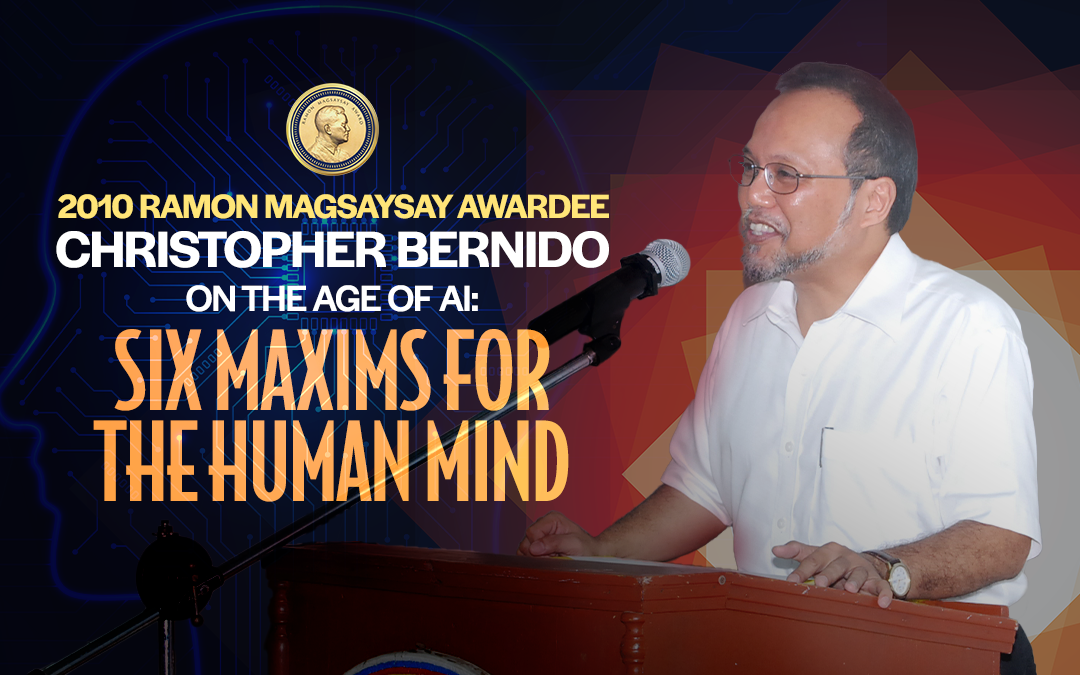
Physicist, educator, lifelong advocate of critical thinking, and 2010 Ramon Magsaysay Awardee Dr. CHRISTOPHER C. BERNIDO explored one of the defining forces of our era: Artificial Intelligence (AI) in his address to the 2025 graduates of MSU–Iligan Institute of Technology.
With the humility of a teacher and the curiosity of a scientist, Dr. Bernido reminded the graduates that AI, like any human invention, is a double-edged tool. “It’s like knives, dynamites, or nuclear power,” he said. “They can be used to harm or to help. The trick is knowing when AI is useful—and when it is harmful.”
From this premise, he offered six maxims—reflections on the limits of technology and the enduring genius of the human mind.
AI harvests both the real and the fake.
AI thrives on data—all kinds of data. It collects the true and the false, the profound and the trivial, the sacred and the absurd.
In doing so, it blurs the line between fact and fiction, making it harder to tell what’s real from what’s merely well-constructed. Dr. Bernido warned that in a world ruled by algorithms, “to see is to believe” no longer holds true. “Our new mantra,” he said, “should be: What is essential is invisible to the eye.”
This insight, borrowed from The Little Prince, is a call for discernment. In the flood of images, data, and simulations, what matters most can’t be seen on a screen. It is found in reflection, empathy, and lived experience—the things AI cannot generate.
The takeaway: The human task is no longer just to see, but to discern.
AI’s strength carries its own weakness.
The power of AI lies in its speed and scale—it can process vast amounts of information faster than any human mind.
But this very strength hides a flaw: the more it processes, the more noise and inaccuracy it absorbs.
AI “hallucinates.” It can overgeneralize, misinterpret, or invent information. As Dr. Bernido explained, even large language models—the engines behind modern AI tools—can produce false scientific conclusions or misleading summaries if not carefully checked.
This is why he emphasized that in the AI age, critical verification is not optional. “The faster AI works,” he said, “the more carefully humans must think.”
The takeaway: Let AI be fast—but let humans be wise.
What you feed AI determines what it becomes.
Unlike humans, AI does not understand context or morality. It simply reflects the data it is trained on.
Garbage in, garbage out—or as Dr. Bernido refined it, “not quite garbage in, garbage out, but the reliability and fidelity of the dataset determine the accuracy of the outcome.”
A wrong prompt or a biased dataset can lead AI astray, generating entire worlds of distortion. “A wrong prompt,” he warned, “can transport us to a different world.”
This makes human intention critical. The algorithms we build—and the information we share—shape the world AI will amplify.
The takeaway: Be mindful of your digital footprint. Every click, post, and prompt contributes to the moral DNA of our machines.
Instant answers weaken curiosity.
AI promises convenience, but it can also make us intellectually lazy.
Why struggle to solve a problem when a chatbot can answer in seconds? Why think deeply when a summary appears instantly?
Dr. Bernido called this the “copy-and-paste culture.” It rewards speed over depth, answers over inquiry.
Citing research from MIT, he explained that students who relied on AI performed worse than those who thought independently—not just in writing, but in neural and cognitive engagement. “AI promotes dependence,” he said. “Our creativity and originality in solving problems are at stake.”
AI should assist, not replace, human reasoning. Learning by doing—through mistakes, experiments, and critical reflection—remains irreplaceable.
The takeaway: Curiosity is a muscle. The less we use it, the weaker it becomes.
AI is fast, but imagination leaps further.
AI runs on code—zeros and ones, bound by physical laws and logic gates.
But the human mind runs on imagination, which defies boundaries. “We can imagine things even if there is still no logical way to achieve them,” Dr. Bernido said.
That ability to envision what does not yet exist—to dream, to hope, to invent—is the essence of human creativity.
While AI can calculate faster, it cannot wonder. It cannot love, fear, aspire, or dream of worlds beyond its programming.
“Our thoughts, our imagination, our intuition, are unconstrained. That is what makes us human. That is what keeps us ahead.” he told the graduates.
The takeaway: Machines simulate intelligence. Humans create it.
Logic has limits; creativity does not.
AI operates strictly by the rules it’s given—it thrives in fixed systems. But when those rules change, it stumbles.
Humans, however, can change the premise. We can invent new frameworks and redefine what is possible. Dr. Bernido called this the “second level of creativity.”
“Humans are adept at creating a new premise or a different set of logical rules,” he said. “That is what it means to think out of the box.”
He illustrated this with the evolution of geometry: when mathematicians broke the rule that parallel lines never meet, they created Riemannian geometry—the foundation of Einstein’s relativity.
Machines obey logic. Humans expand it.
The takeaway: The future belongs not to those who calculate, but to those who imagine beyond the calculation.
Dr. Bernido concluded his talk with a thought from A Beautiful Mind, where mathematician John Nash reflects that true logic is ultimately found in love.
For the physicist from Bohol, Philippines, this was not sentimentality but science of the soul.
True intelligence—whether human or artificial—is incomplete without compassion.
Logic may drive progress, but love gives it purpose.
The takeaway: The highest intelligence is empathy.
Fifteen years after receiving the Ramon Magsaysay Award with his wife, Ma. Victoria Carpio-Bernido for “their purposeful commitment to both science and nation, ensuring innovative, low-cost, and effective basic education even under Philippine conditions of great scarcity and daunting poverty,” Dr. Christopher Bernido continues to teach not just how to think, but how to remain human in an increasingly automated world.
In an age of machines that can mimic language, art, and reasoning, his message rings clear: what makes us human is not our logic, but our imagination, our discernment, and our capacity to love.
“Our thoughts, our imagination, our intuition—these are unconstrained. That is what makes us human. That is what keeps us ahead.”