
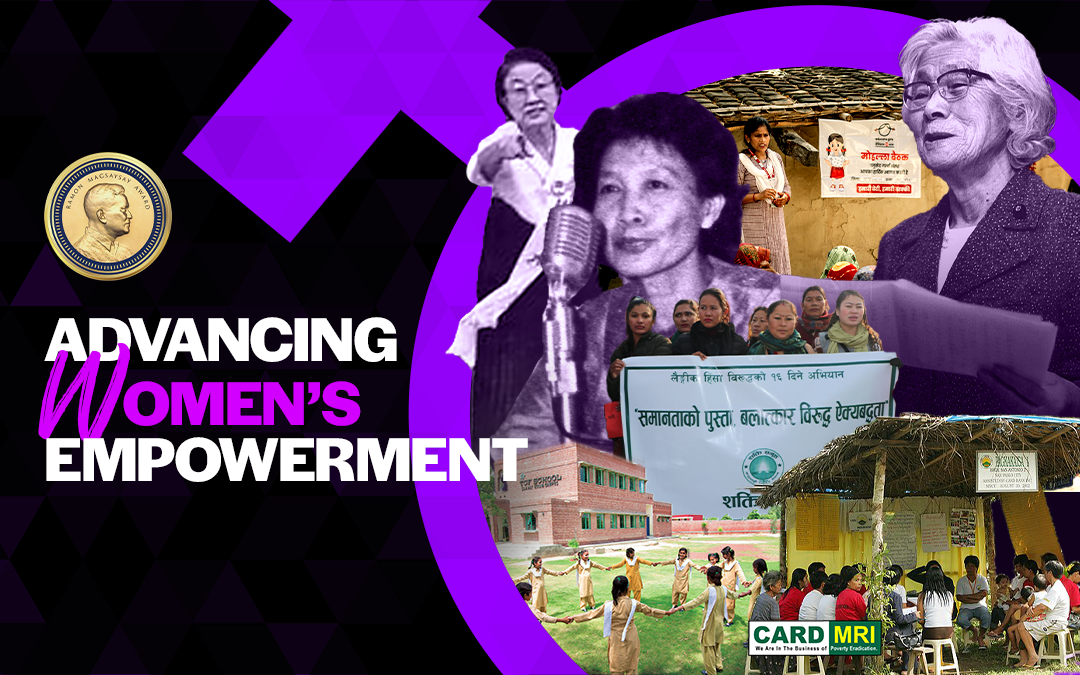
For nearly seven decades, the Ramon Magsaysay Award has honored individuals and organizations whose leadership has transformed lives across Asia. Among them are champions who expanded opportunities for women—through education, political rights, economic inclusion, and protection from exploitation—long before “women’s empowerment” became a widely used phrase.
As the world marks International Women’s Day and reflects on this year’s theme, “Give to Gain,” the legacy of the Ramon Magsaysay Award shows that investing in women has always produced enduring gains for families, communities, and entire societies.
From pioneering feminists and legal reformers to educators, community leaders, and social innovators, these Ramon Magsaysay Awardees demonstrate how advancing women’s rights strengthens the social fabric of nations. Notably, this work has been carried forward by both women and men who recognized that empowering women is not solely a women’s issue—it is a societal responsibility.
The following Ramon Magsaysay Awardees illustrate how this commitment has taken shape across Asia over the past 67 years.
In 1961, Thai feminist NILAWAN PINTONG, a Ramon Magsaysay Awardee from Thailand, used journalism as a tool for social change. Through the women’s magazine Satri Sarn, she opened a public space where women—particularly those in rural communities—could encounter new ideas about civic life, education, and participation. Her work expanded into youth publications, news weekly, and radio programming that encouraged broader engagement in public affairs.
More than a decade later, FUSAYE ICHIKAWA, a1974 Ramon Magsaysay Awardee from Japan, helped reshape the political landscape of her country. A central figure in Japan’s women’s suffrage movement, she campaigned tirelessly to secure women’s right to vote and to run for public office. Even after suffrage was achieved, she continued advocating for women’s participation in political leadership, ensuring that the democratic process reflected women’s voices.
Breaking barriers in the legal profession, LEE TAI-YOUNG, a 1975 Ramon Magsaysay Awardee from South Korea, became the country’s first woman lawyer and devoted her career to reforming discriminatory family laws. Through legal advocacy and the establishment of legal aid services for women, she worked to secure equal rights in marriage, inheritance, and child custody—protections that continue to shape Korean society today.
Economic empowerment for women took a transformative turn in 1980s when MUHAMMAD YUNUS, a 1984 Ramon Magsaysay Awardee from Bangladesh, pioneered the concept of microcredit. By extending small, collateral-free loans primarily to poor rural women, he enabled millions to build small enterprises, educate their children, and stabilize their households. His work demonstrated that women are among the most reliable drivers of economic resilience.
In China, 2001 Ramon Magsaysay Awardee WU QING, an educator and legislator, devoted her career to advancing women’s rights through education and policy reform. She introduced one of the country’s earliest university courses on women’s studies and established programs that equipped rural women with literacy, legal awareness, and livelihood skills. By linking grassroots education with legislative advocacy, she strengthened women’s ability to participate fully in civic life.
Across the Philippines, financial inclusion became a powerful pathway for women’s advancement through the work of the CENTER FOR AGRICULTURE AND RURAL DEVELOPMENT MUTUALLY REINFORCING INSTITUTIONS (CARD MRI), a 2008 Ramon Magsaysay Awardee. Built on the belief that “nanays” (mothers) are the backbone of families and communities, CARD-MRI developed microfinance programs tailored for women—combining credit, savings, insurance, and training. What began as a modest rural initiative has grown into one of the country’s largest microfinance networks, enabling millions of women to become entrepreneurs and leaders in their communities.
Education also became a powerful equalizer through HASANAIN JUAINI, the 2011 Ramon Magsaysay Awardee from Indonesia. In West Lombok, he established a girls’ Islamic boarding school that integrates religious learning with science, environmental awareness, and life-skills training. In communities where opportunities for girls were often limited, Juaini chose to challenge convention—not by discarding cultural values, but by expanding them to include women’s education and leadership. His work reminds us that advancing women’s rights is not only the work of women; it is a responsibility shared by men who recognize that communities thrive when girls are given the chance to learn and lead.
In Nepal, survivors of human trafficking organized themselves to support others facing the same trauma. Their organization, SHAKTI SAMUHA, a 2013 Ramon Magsaysay Awardee, provides shelter, legal assistance, education, and livelihood training for trafficked women and girls. By transforming survivors into advocates and community educators, the group has strengthened both prevention and protection efforts against trafficking.
Education for marginalized children—particularly girls—has been the driving mission of THE CITIZENS FOUNDATION (TCF), a 2014 Ramon Magsaysay Awardee from Pakistan. Through a nationwide network of purpose-built schools in underserved communities, TCF has created learning environments where girls can pursue education safely and confidently. By recruiting female teachers and actively engaging families, the organization has helped shift attitudes toward girls’ education across the country.
Most recently, EDUCATE GIRLS, 2025 Ramon Magsaysay Awardee from India, has worked to close persistent gender gaps in education across rural communities. Through grassroots engagement, mentorship programs, and partnerships with local leaders, the organization has helped enroll and retain hundreds of thousands of girls in school. Their work addresses structural barriers—from poverty to restrictive social norms—while nurturing confidence and leadership among the next generation of women.
Across decades and diverse contexts, these Ramon Magsaysay Awardees demonstrate that empowering women strengthens societies as a whole. Their work affirms a truth long reflected in the Award’s history: when women are given access to education, economic opportunity, justice, and leadership, communities gain stronger foundations, wider opportunities, and more resilient futures.
Since 1958 the Ramon Magsaysay Award has honored individuals and organizations whose leadership embodies this belief—showing that advancing women’s rights is not only a matter of equity, but a foundation for lasting social progress.